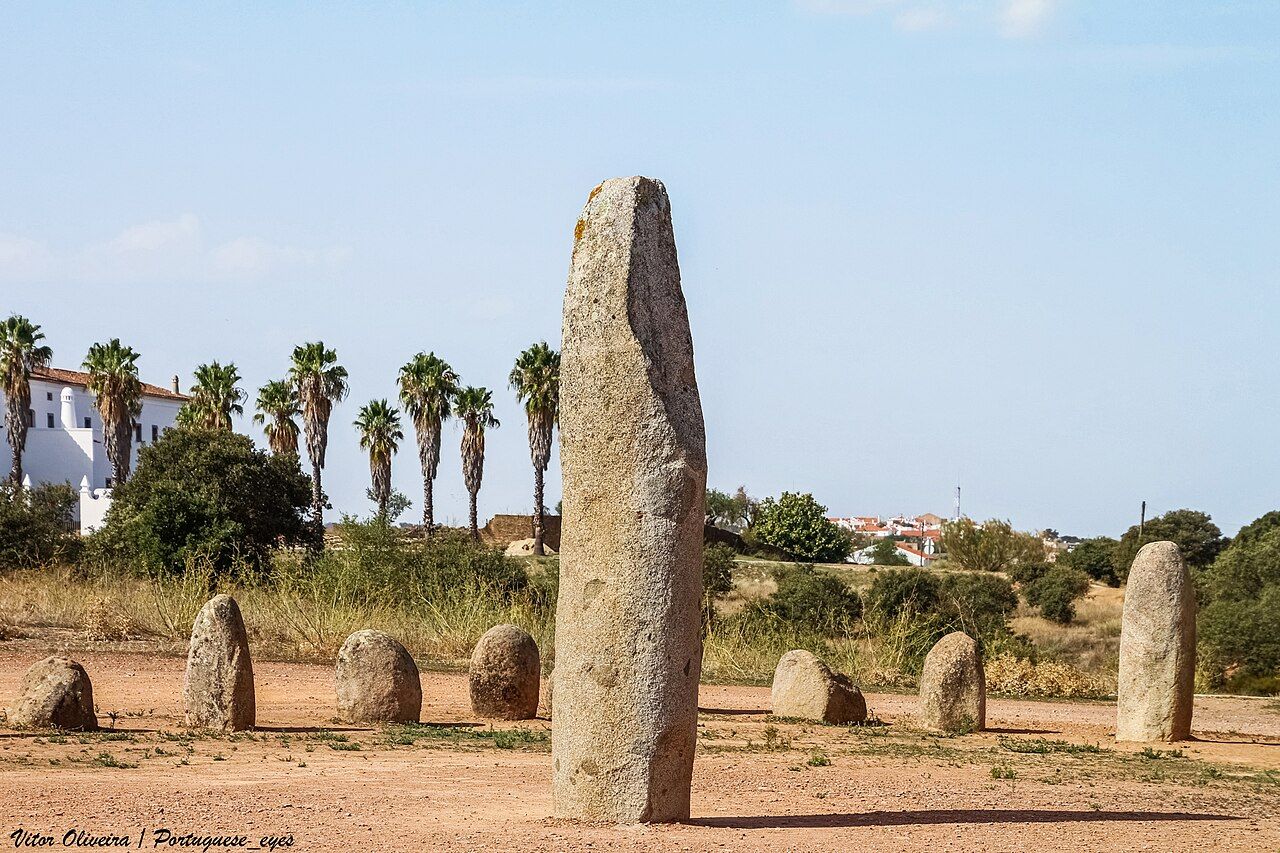
Menhirs, dolmens and stone circles.
That is the plain inventory, but the stones around Monsaraz are more interesting than a list makes them sound. I like this short circuit for its variety: a square arrangement with a central menhir, stones marked with lines and circles, a large dolmen and a rock tied to an old marriage tradition. The countryside is rich in megaliths, raised by farming communities in the Neolithic and Chalcolithic periods. Most stand in open fields among olive trees and holm oaks. They belong to the landscape without needing much introduction.
Questions and answers
What is the Cromeleque do Xerez?
The Cromeleque do Xerez is a square arrangement of standing stones around a tall central menhir. It originally stood in a valley that was flooded by the Alqueva lake; the stones were moved and rebuilt near the Convento da Orada below Monsaraz. That change is hard to ignore. A circle of stones is already a striking thing; knowing this one was taken apart and set up again makes the arrangement feel both ancient and surprisingly practical. It is not in its original place, but the square and its central stone are still there to read.
For another stone-circle reference, there is the great stone circle at Almendres.
Which menhirs are worth looking for?
The Menhir da Bulhoa, near the village of Telheiro, is carved with lines and circles. I find that detail the most persuasive sort of invitation to look closely: not a grand explanation, just marks on stone that have lasted. The Menhir do Outeiro is one of the tallest standing stones in the Iberian Peninsula. Those are different kinds of interest, and I would not try to rank them. One draws the eye with its carved surface; the other with its height. Both make a good case for getting out among the fields rather than treating the megaliths as a single stop.
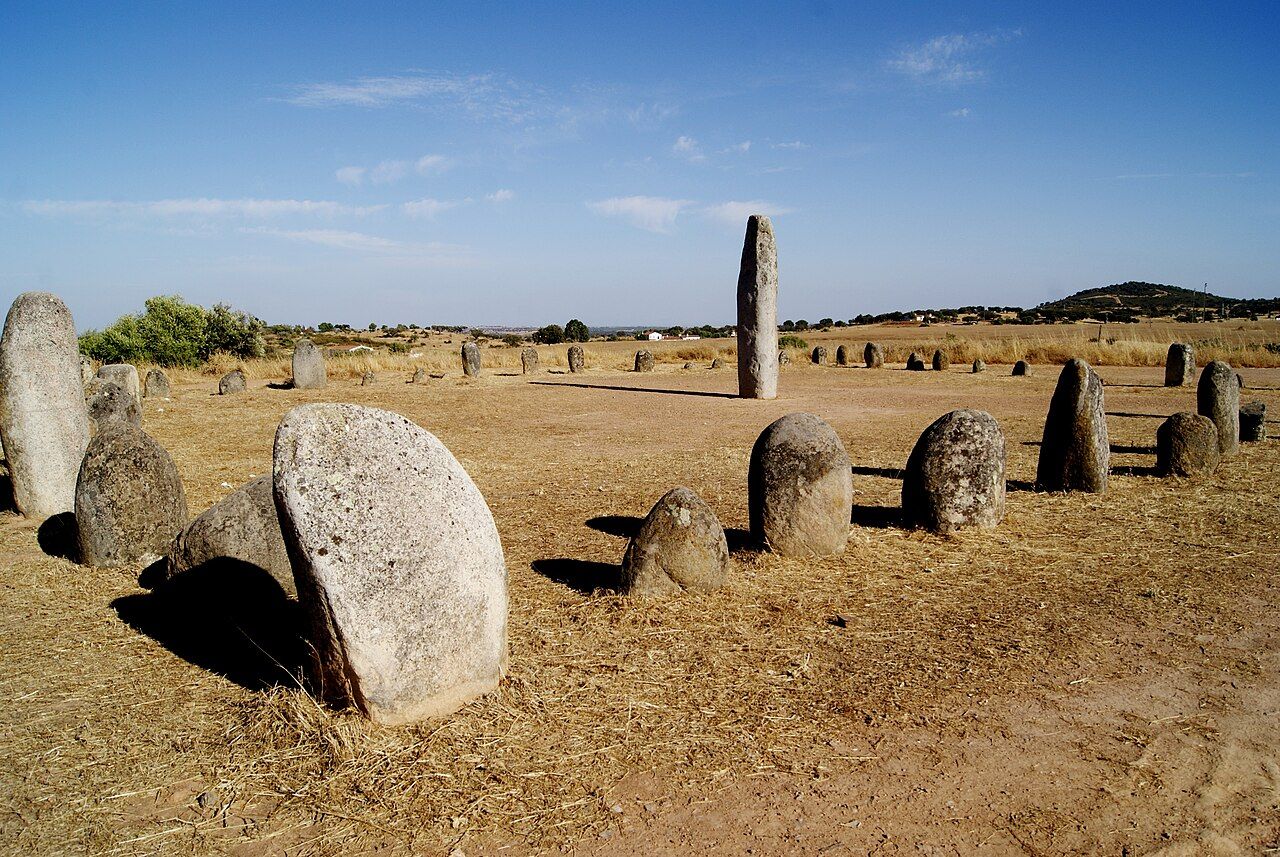
Is there a dolmen on the circuit?
Yes. The Anta do Olival da Pega is a large dolmen near Reguengos de Monsaraz. It gives the circuit a change of form from the standing stones: the word dolmen is not just another name for a menhir, and seeing the range of monuments is the point. There is also the Rocha dos Namorados, a rock near São Pedro do Corval linked to an old tradition about marriage. It is an appealingly different kind of story, less about arrangement or height and more about what people have attached to a particular stone.
For another thread in São Pedro do Corval:
How do I find the monuments?
Signposted roads lead to the main monuments from Monsaraz and Telheiro. Most of the stones are in open fields among olive trees and holm oaks, so I prefer to think of the circuit as a string of separate encounters, not one monument with a few extras. The facts that matter at the end are simple: the main sites are reached by signposted roads from those two places, and the Cromeleque do Xerez stands near the Convento da Orada below Monsaraz. My habit of counting steps is no use with this many stones; I keep losing count before they do.
Photos by Ceinturion, CC BY-SA 4.0; Jazz8383, CC BY 4.0