“Eight sub-regions.”
That is the useful starting point for Alentejo wine. The DOC Alentejo appellation is divided into eight sub-regions, which gives the region a shape more precise than one broad name on a label. I like that distinction: it offers a way into the subject without pretending that every wine can be explained by a single map, grape or rule. The names are worth knowing, but they are not a test to pass before tasting. I count them as I go; it is a habit that gives a list the satisfying feel of a walk with a destination.
The sub-regions are Portalegre, Borba, Redondo, Évora, Reguengos, Granja-Amareleja, Vidigueira and Moura. Borba, Redondo and Reguengos are the closest to Alandroal, so they make a natural place to begin if the question is what lies nearby. I would resist treating that proximity as a ranking. The regional map is more useful as orientation than as a league table, and there is no need to turn a primer into a contest between names. The three nearby areas are easy to keep together in the mind: the three nearby wine areas.
Two labels
DOC Alentejo is not the only label to know. Vinho Regional Alentejano covers the whole region, with looser rules than the DOC. That is the straightforward difference, and it is enough for a first pass. I find labels most helpful when I let them tell me what category of rules I am looking at, rather than asking them to tell me in advance whether I will like what is in the bottle. The useful distinction is between the DOC Alentejo and the Vinho Regional Alentejano label, not between a serious wine and an unserious one.
The useful distinction is between the DOC Alentejo and the Vinho Regional Alentejano label, not between a serious wine and an unserious one.
Wines of the region are overseen by the Comissão Vitivinícola Regional Alentejana. The name sits behind the appellation and its rules; for a reader, the practical point is simply that DOC Alentejo and Vinho Regional Alentejano are not interchangeable labels. One is the appellation divided into its sub-regions, and the other is the regional label with looser rules. I prefer keeping that difference clear to memorising a longer set of technical terms before I have even looked at the grapes.
The grapes
The common red grapes are Aragonez, Trincadeira, Alicante Bouschet and Castelão. Aragonez is the local name for Spain’s Tempranillo, a useful bit of translation when the grape appears under a different name. Alicante Bouschet is the one that stands out in the list for a specific reason: it has red flesh as well as red skin, giving deeply coloured wines. That is a fact worth keeping in mind, not a promise that every bottle will taste the same. A grape name can be a clue; it is not the whole story.
The common white grapes are Antão Vaz, Roupeiro and Arinto. I would leave the list there rather than attach tasting notes that these facts do not give us. For a primer, names are enough: they make the regional vocabulary less opaque, and they give a tasting some points of reference. There is pleasure in recognising a grape, but I find it a poorer pleasure than actually paying attention to the wine. The list should open a door, not turn into homework.
Heat and clay
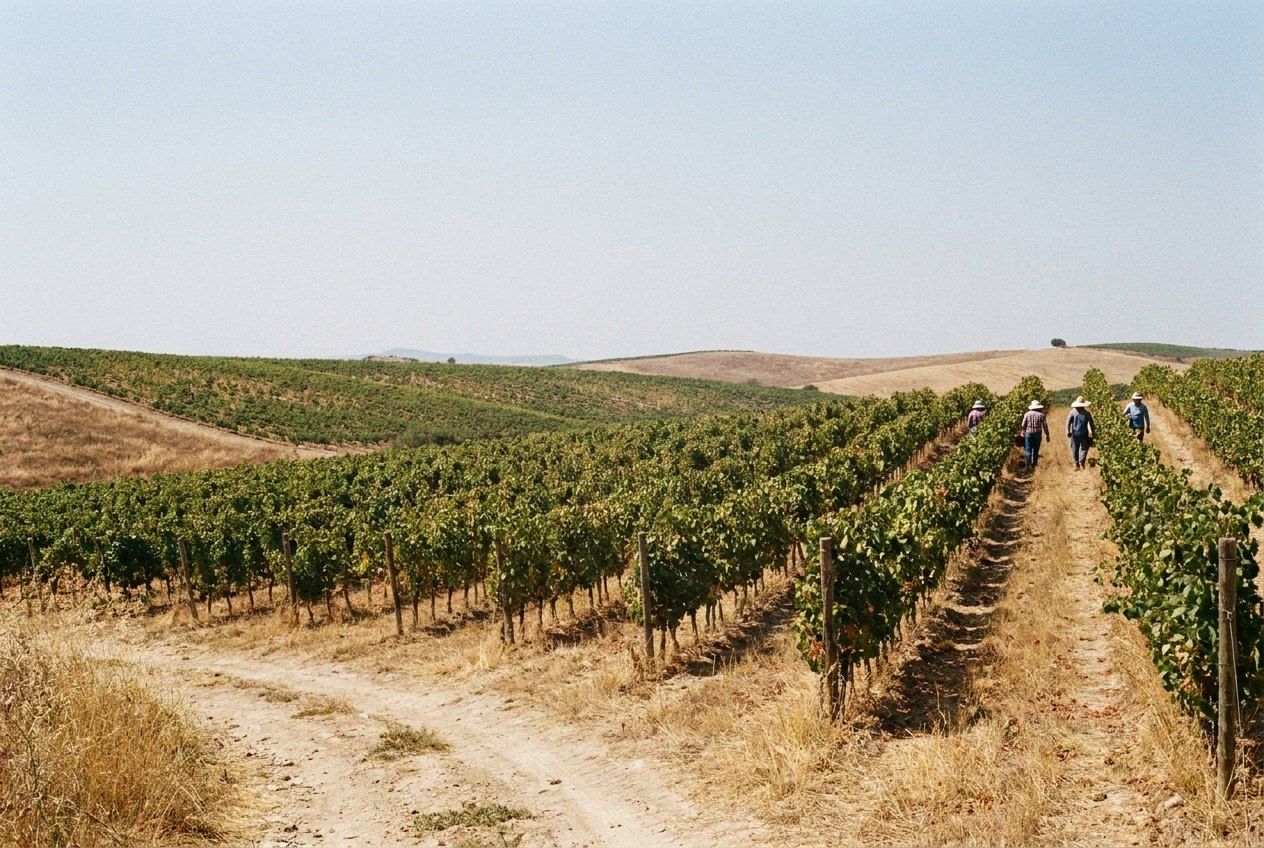
Hot, dry summers ripen the grapes fully, and the reds are typically ripe and full-bodied. That is the clearest link between climate and style here. It gives the red wines a broad outline before any tasting begins, while leaving room for the differences between grapes and sub-regions. I like a broad outline: it is useful, provided it stays broad. “Typically” matters. It describes the regional tendency without claiming that every wine follows it to the letter.
There is another part of the DOC worth knowing before a tasting: it also recognises wine made in clay pots, as DOC Alentejo Vinho de Talha. The name is specific, and the clay pots are the point. I would not file this away as a minor curiosity simply because it sits beside the better-known grape names. It gives the appellation another category to look out for, without requiring a detour into claims about its taste or production. The label to remember is talha wine.
For anyone who wants to taste rather than only read, the Rota dos Vinhos do Alentejo is a wine route that groups estates open to visitors. Many wine estates in the region offer tastings in their cellars. Those are the practical details I would keep until last: first the names, labels and broad climate; then the possibility of tasting. It is a sensible order. A route gives the region a framework, while a cellar tasting gives the words something concrete to sit beside. No elaborate theory is required to get started.
So the primer, in brief: eight sub-regions; a DOC and a broader Vinho Regional label; familiar red grapes alongside white ones; hot, dry summers and typically ripe, full-bodied reds; and DOC recognition for wine made in clay pots. I can count the eight sub-regions on my fingers; the grapes can take care of the wine.