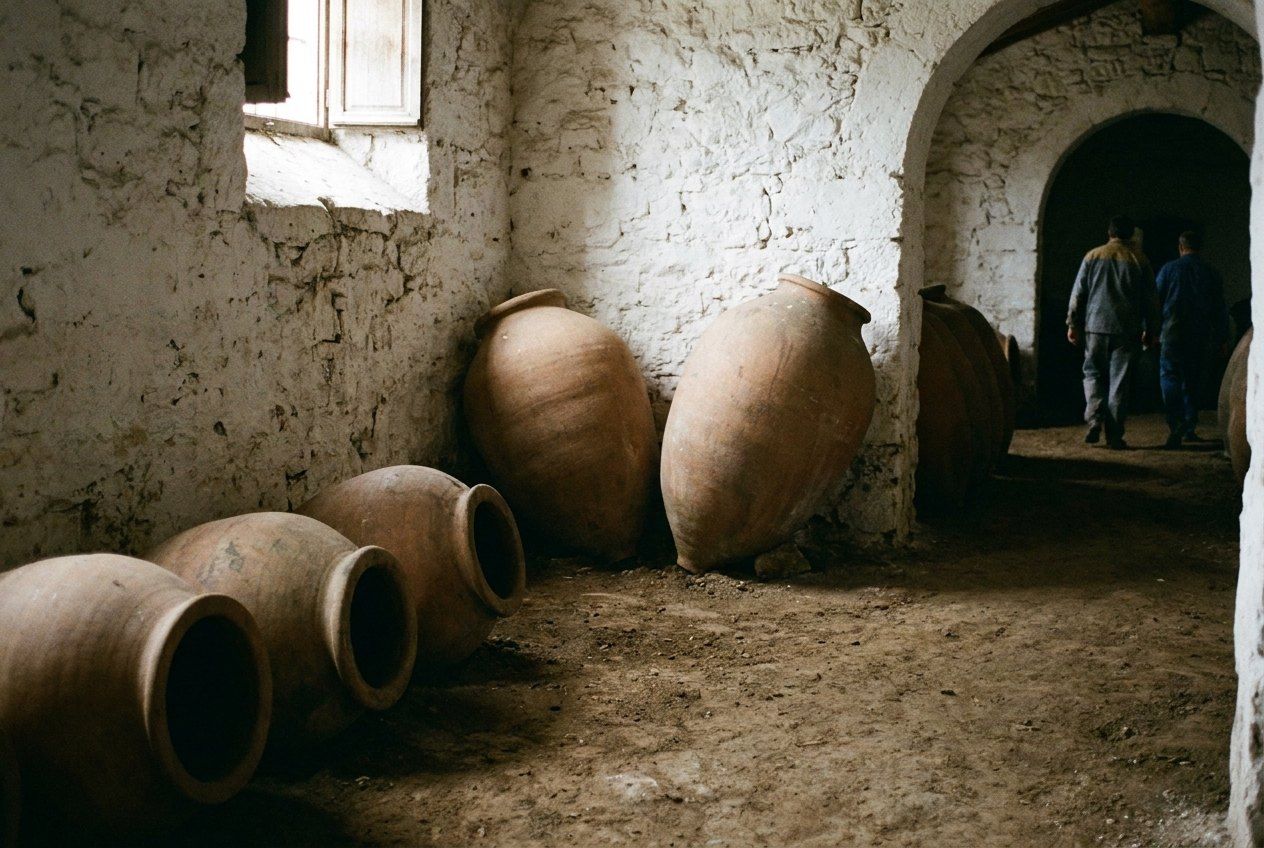
I count steps out of habit, but with talha wine it is the scale of the vessel that holds me up. A clay jar can take well over a thousand litres. That is a lot of wine to leave to a method that sounds, at first, almost disarmingly simple.
What is talha wine?
Vinho de talha is wine fermented in large clay jars called talhas. The method has been used in the Alentejo since Roman times, and it is still alive here. I like that it asks for no elaborate explanation: grapes, a jar, time for fermentation, and hands doing the work that needs doing. The simplicity is real, but it is not the same as a lack of care.
The inside of each talha is lined with pez, a coating of pine resin that seals the clay. I find that detail more interesting than any grand claim about ancient traditions. The jar is not just a container; the lining is part of how it is prepared for the wine. You can trace the method through its materials, from clay to resin to grapes.
How does the wine ferment?
The grapes are crushed and put into the talha with their skins. As fermentation gets under way, the cap of skins is pushed down by hand with a wooden tool. There is something appealingly direct about that task: not a flourish for visitors, but a part of the process itself. I would rather hear about the hand and the tool than be told the method is mysterious.
After fermentation, the skins settle at the bottom and act as a natural filter. The wine is drawn off through a tap near the base of the jar. Each step follows from the one before it: skins go in with the grapes, are pressed down during fermentation, then settle and filter the wine. The talha does a lot of the explaining without needing to be dressed up in grand language.
Where is talha wine made?
Vila de Frades, in the municipality of Vidigueira, is the best-known centre of talha wine. The method belongs to the wider Alentejo wine story, and it sits neatly alongside the different character of the Alentejo wine sub-regions. I would start with the jar and the method, though, rather than trying to make every glass stand for an entire region.
Talha wine is recognised as DOC Alentejo Vinho de Talha. Taverns in the region serve the new wine straight from the talha, which seems to me the clearest way to understand why the vessel remains central. It is not simply a name for an old style of wine-making; the jar is part of the story from fermentation through to the pour.
When is the new wine opened?
By tradition, the new talha wine is opened on St Martin’s Day, 11 November. I like a custom that gives the wine a point of arrival: the grapes have been crushed, fermentation has taken place in the jar, the skins have settled, and now the new wine is opened. There is no need to add ceremony to the explanation. The date does enough.
There is another Alentejo food thread to follow in
but talha wine makes most sense when I keep my attention on the vessel: its clay, its lining, and the steady sequence of work inside it.
For me, the jar is the best part of the story: practical, enormous, and still doing its job.
Photos by Francisco Antunes, CC BY 2.0; Kolforn ( Kolforn ) I'd appreciate if you could mail me (Kolforn if yo, CC BY-SA 4.0