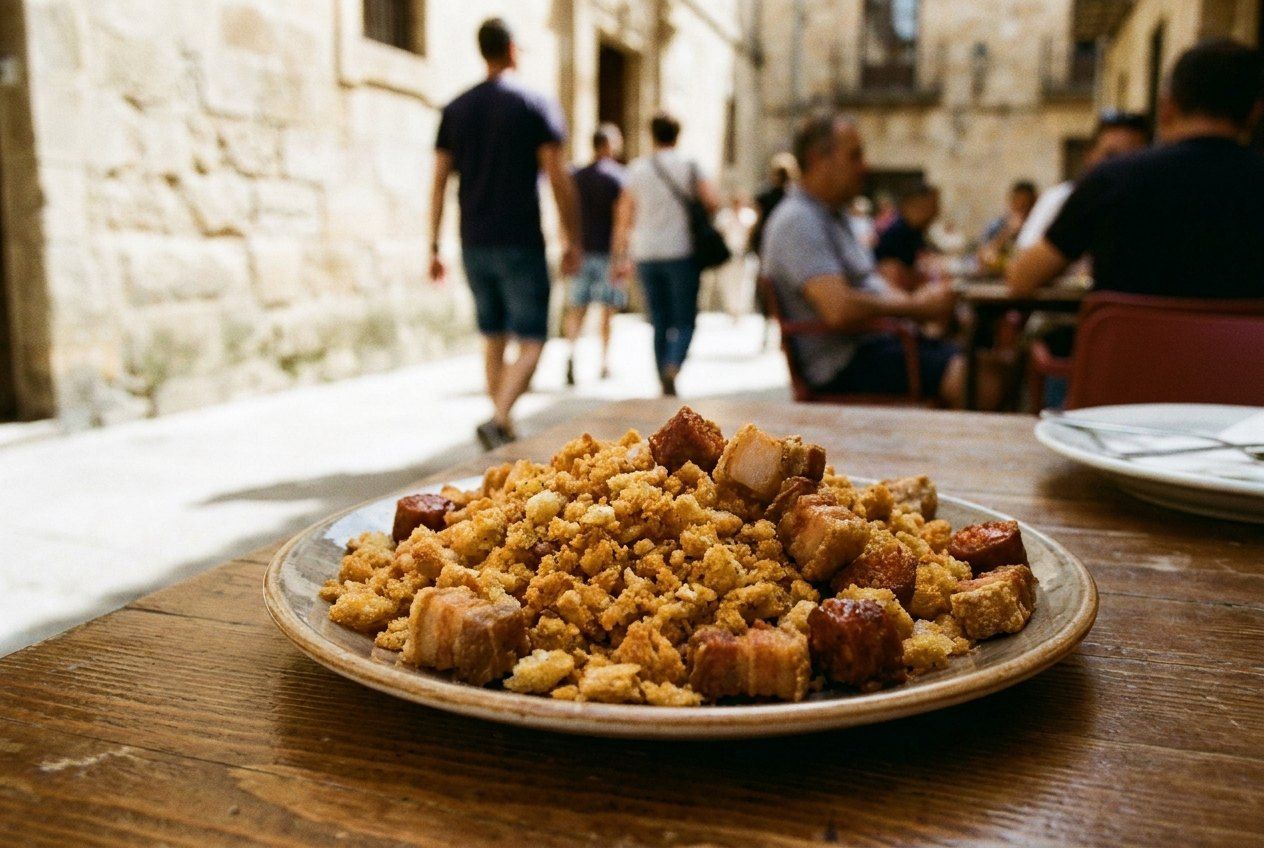
I have a habit of counting steps. With migas, I count the changes instead: a dense loaf becomes moistened bread, then something worked in a pan until it holds together. It is a satisfying sort of kitchen arithmetic, and the result has more character than its thrifty beginnings might suggest.
What are migas?
Migas are made from day-old Alentejo bread, a dense wheat loaf. The bread is moistened and broken up, then fried with garlic in pork fat or olive oil. The point is not to make a tidy pile of crumbs. Work it in the pan and it comes together in a loose roll, with a golden outside. That transformation is the whole appeal for me: humble bread, made into something with its own presence on the plate.
Why use day-old bread?
Because old bread was never thrown away in the frugal country cooking from which migas grew. That is the reason the dish exists, and I like that it does not try to disguise it. The bread is put to use, rather than replaced by something more elaborate. Garlic gives it its savoury base; fat helps it fry and bind. It is practical cooking, but it is not joyless cooking.
Why is pork fat part of the story?
Migas are usually served with fried pork, often pieces marinated in red pepper paste. The paste is called massa de pimentão, and is used across the Alentejo to season pork. Then comes the neat bit: the fat left from frying the pork is used to fry the migas. Nothing is wasted, and the side dish picks up the flavour of the cooking already under way. I think of black pork fed on acorns as a neighbouring subject; here, the important detail is that the pork fat gets a second job.
Are all migas the same?
No, and the variations are worth knowing. Migas com espargos are made with wild asparagus picked in spring. Other versions use tomato or salt cod. The bread is the common thread, not a fixed list of additions. I’d start with the version that sounds best beside the meal, rather than treating one variation as the official one. The asparagus version has a particular seasonal ingredient; tomato and salt cod take the dish in different directions without changing its basic idea.
What should I expect on the plate?
Think of migas as a side dish, usually alongside fried pork, rather than a dish built around a separate sauce or a grand garnish. Its loose roll and golden outside make it more substantial than the word “side” might imply. The bread remains the centre of the matter, with garlic and the frying fat doing their quiet, useful work. I prefer that plain explanation to pretending the dish needs a grander one.
Where can I find them?
Migas are served all over the region and appear on the menus of most traditional restaurants in the Alentejo. That makes them a useful dish to recognise: the name tells you that bread is doing the work, while the menu can tell you which version is on offer. And if anyone calls day-old bread past its best, migas are ready to contradict them. Stale bread gets the last laugh.