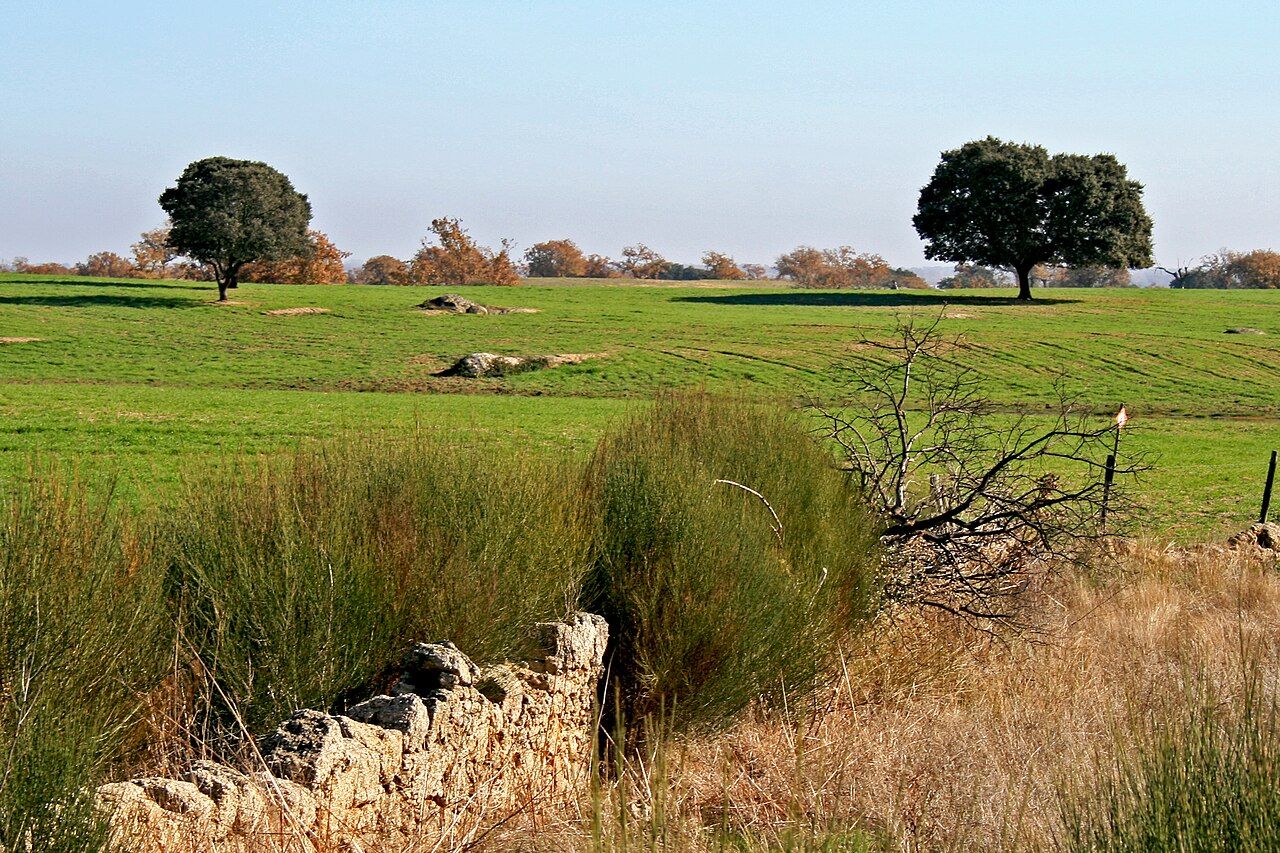
“Open woodland” is the phrase that gets closest to the montado, though it leaves out the useful bit: this is a farming system. Around Alandroal, scattered cork oaks and holm oaks stand over pasture or cereal fields, with room between the trees for grass and crops to get light. I like that plainness. It is neither a closed forest nor a field cleared of trees, but land doing several jobs at once. In Spain, the same landscape is called the dehesa; here, montado is the word I find myself returning to.
Trees with room around them
The spacing matters. The trees are not packed together; they are widely spaced so that pasture and crops can grow beneath them. That arrangement is the heart of the place, and more interesting to me than a simple tally of how many trees there are. I have a habit of counting steps, but here I would rather notice the gaps: between one trunk and the next, and between the shade and the open ground. The land is being used as woodland and as farmland at the same time.
The holm oak, or azinheira, has small dark leaves and sweet acorns. The cork oak, or sobreiro, is the one with thick, spongy bark, which is taken for cork in the cork harvest. They are easy to distinguish in description, even if I am not going to pretend that recognising a tree makes me an expert. What matters is that both belong to this open landscape, and both are protected by law. Felling either needs official permission, a practical reminder that these trees are not just convenient parts of a field.
The cork oak has a particular place in Portugal. Portugal is the world’s largest producer of cork, and the cork oak was declared the national tree in 2011. I find that combination satisfying: a tree that is part of a working landscape, and whose bark has a use, is also given a national standing. Its thick, spongy covering is not a detail to skim over. It is the reason this tree gives the montado something that the holm oak does not.
The cork oak can live for well over a hundred years. That length of life changes how I think about the scattered trees. They are not a temporary dressing on the fields, there for a season and gone by the next. They belong to a longer view of the land, while pasture and crops occupy the space beneath them. The trees are far enough apart to leave that space usable. It is a neat arrangement, though “neat” makes it sound tidier than a working countryside needs to be.
Grazing and the turn of the year
Cattle, sheep and black pigs graze under the trees. I like the fact that the list includes different animals, rather than turning the montado into a vague picture of “livestock”. This is a shared landscape: trees above, animals below, and pasture or cereal fields making use of the light between them. The montado is open woodland, but it is also a farming system. That is the sentence I would keep if I had to leave the rest behind.
The montado is open woodland, but it is also a farming system.
Its seasonal change is clear without needing much ornament. In spring, the pasture is green and full of wildflowers. By summer, it turns gold and dry. I prefer the spring description, with its green ground and flowers, but the summer version belongs here too; this is a landscape that changes, not a fixed scene to be admired in one approved condition. The trees stay the defining presence, while the ground beneath them shifts from one description to the other.
There is wildlife in the farmland as well as grazing animals. The azure-winged magpie, a blue-tailed bird of the oak woods, is common here. Hoopoes and white storks are easy to spot in the farmland around Alandroal. Those are useful details because they make the landscape feel inhabited in more than one sense. I would not dress them up with imagined calls or behaviour; the simple fact of their presence is enough to bring the open ground into focus.
What I value most about the montado is the way its different parts remain legible. The scattered trees, the pasture or cereal fields, the animals grazing beneath them: none needs to be explained away as decoration. The cork oak gives the landscape a product and a long-lived presence; the holm oak brings its small dark leaves and sweet acorns; the open spacing lets crops and grass have their share of the light. Around Alandroal, this is not a backdrop with farming added to it. It is the farming landscape.
Cork oaks and holm oaks are protected, and felling them needs official permission. I like that as a final detail, because it puts the value of the trees in practical terms rather than leaving it as sentiment. The montado works because trees, grazing and crops share the same land. I’d take that over a field with nothing to say for itself.
Photos by Kolforn ( Kolforn ) I'd appreciate if you could mail me (Kolforn if yo, CC BY-SA 4.0; Vitor Oliveira from Torres Vedras, PORTUGAL, CC BY-SA 2.0