“Good news.”
What is the Sanctuary of Nossa Senhora da Boa Nova?
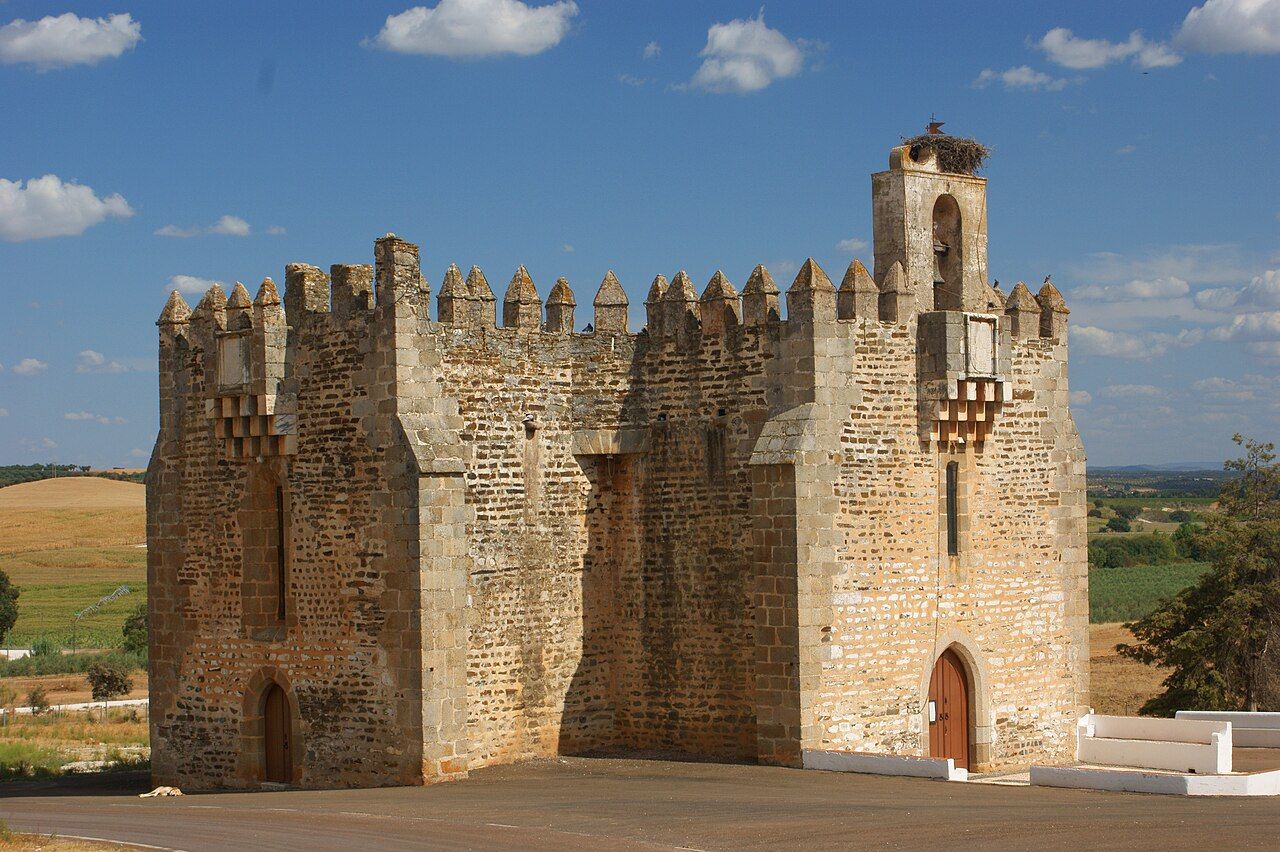
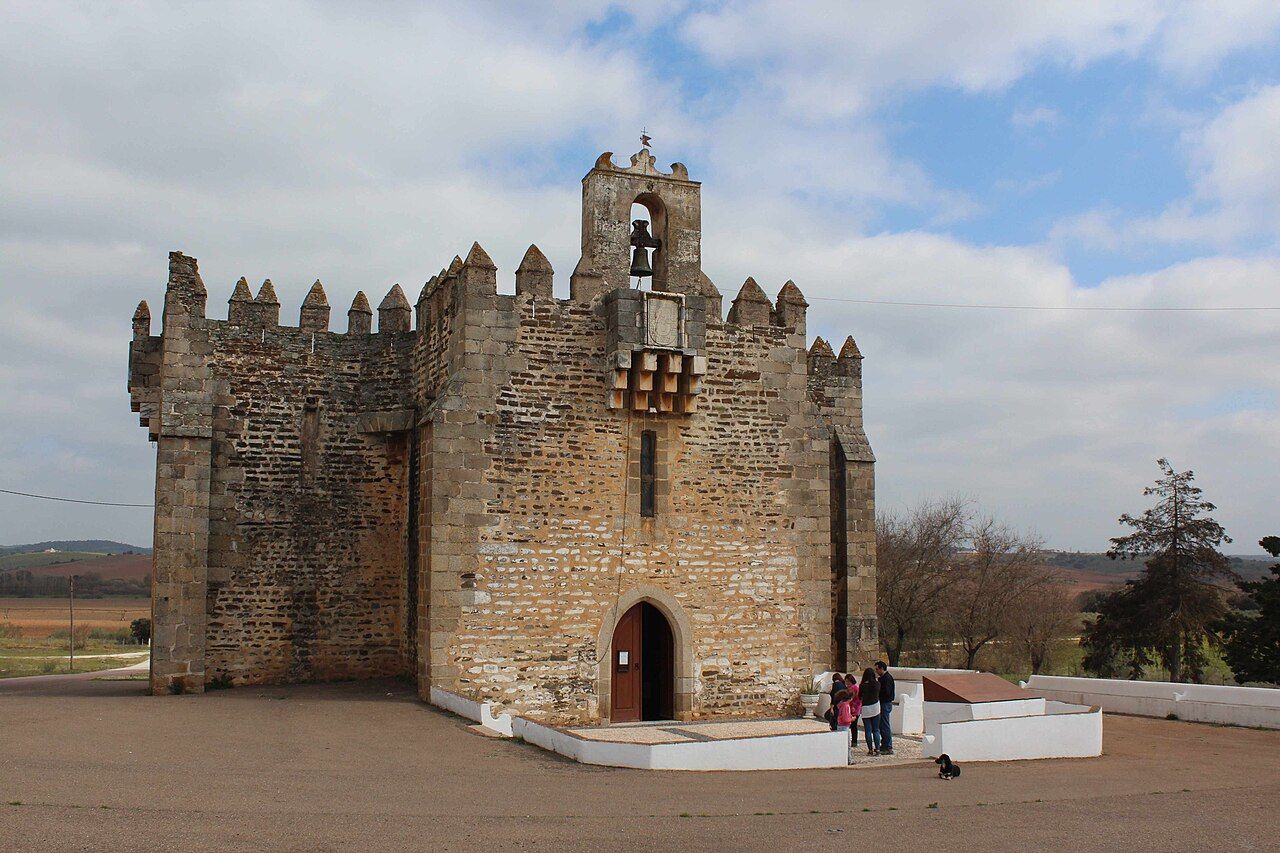
It is a fortified church on the edge of Terena, in the municipality of Alandroal, built in the 14th century. Battlements run along the roofline; the walls are thick enough to give the building the look of a small castle. I find that combination hard to ignore. This is not a church that settles quietly into the background: its blocky silhouette is visible from the road as I approach Terena, and it gives the place a distinct outline before I have reached the village itself.
Its plan is a Greek cross: four arms of equal length arranged around a central space. That is a clear, spare idea, and it suits the building’s solid exterior. I like the contrast between the exactness of the plan and the almost defensive impression made by the battlements. It is a church, certainly, but it borrows the language of a fortress without pretending to be anything else.
Why is it called Boa Nova?
Boa Nova means “good news”. Tradition links the name to the Christian victory at the Battle of Salado in 1340. The battle was fought near Tarifa in southern Spain, where Portuguese and Castilian armies defeated a Marinid army from Morocco. That is the historical event attached to the name, and the royal tradition is part of what gives the church its particular character.
Tradition also links the church to Queen Maria of Portugal, daughter of King Afonso IV and wife of Alfonso XI of Castile. I would keep that story in its proper place: it is a tradition associated with the church, rather than a licence to embroider the tale with details that are not here. The name and the royal connection are compelling enough without additions.
What is inside?
The walls and vaults carry old painted decoration. Against the sturdy exterior, that detail shifts the emphasis from the church as a small castle to the painted surfaces within it. I am glad the building offers both impressions. Its shape is the first thing that catches the eye, but the old decoration belongs to the part of the story that cannot be read from the road.
The devotion to the Virgin in Terena reaches further back than the church itself. A cult of the Virgin was present long before the building was built, and it is recorded in the 13th-century Cantigas de Santa Maria. That earlier record gives the church a deeper local context: the building is not the beginning of the devotion, but a later expression of it.
How do I reach it?
The church stands among olive groves and fields below the village, and it can be reached on foot from the village of Terena. I would make that approach part of the visit rather than treating the church as a quick view from the road. Its position below the village and its strong outline make more sense together than either does on its own.
For a building on the edge of Terena, it has a presence that is out of proportion to its size. The battlements make the first argument; the plan, painted decoration and traditions give it staying power. I find it one of the most unusual buildings in the Alentejo, and the word “unusual” feels rather too mild.
Photos by Carlos p. gonçalves, CC BY-SA 4.0; Vitor Oliveira from Torres Vedras, PORTUGAL, CC BY-SA 2.0