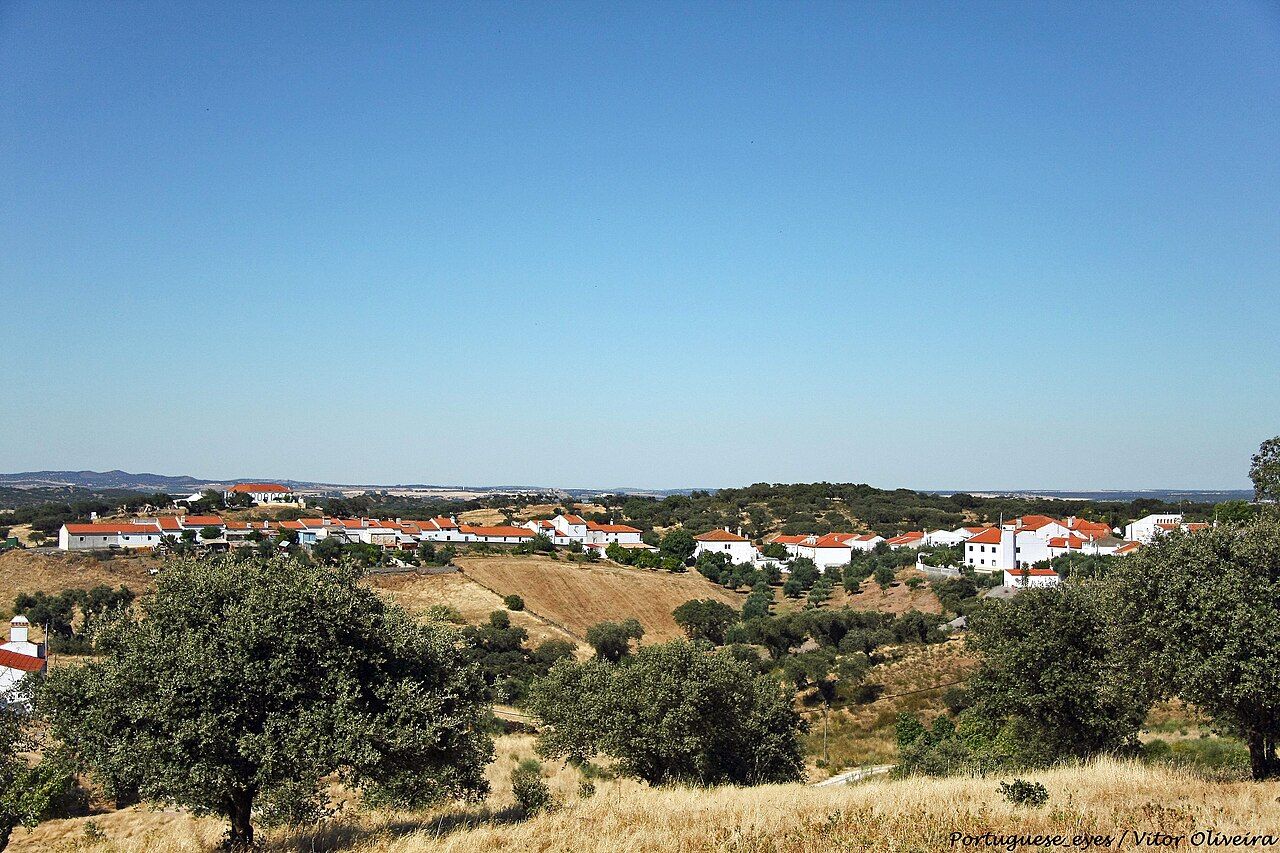
I have a habit of counting steps; in Mina do Bugalho, my attention would rather count the village details: white houses, chimneys and the spaces between them. There is a particular pleasure in places that do not need to make a show of themselves. These villages are modest, and that is their strength.
What is São Brás dos Matos?
São Brás dos Matos is a parish of Alandroal, and its main village is Mina do Bugalho. The names can be a little untidy on a map: in 2013, a national reform joined the parishes of Alandroal, São Brás dos Matos and Juromenha into a single union of parishes. Mina do Bugalho remains the name to keep in mind for the village itself. I find the distinction useful, but the lived scale here is small-house, village, surrounding fields; not administrative boundaries.
What are the villages like?
Mina do Bugalho, Capelins and Santiago Maior are small clusters of white houses among fields, olive groves and holm oak pasture. Capelins and Santiago Maior are rural parishes in the south of the municipality. Many houses have a large chimney and a bread oven built into the house, which feels like a more convincing piece of local character than any grand gesture. In the Alentejo, an isolated farmstead is called a monte, and many hamlets grew from one. The village pattern makes more sense when I think of these beginnings than when I try to make the places sound grander than they are. The pasture brings to mind the cork and holm oak woods.
What stands out in the village?
The parish church is usually the tallest building, and white storks often nest on the bell towers here. I like that simple hierarchy: the church above the roofline, the houses gathered close around it. It gives the village a clear centre without making the place feel staged. There is no need to hunt for a grand monument in every settlement; the buildings are interesting in their own everyday proportions.
What is village life like?
The roads between the villages are quiet, passing fields where cattle and sheep graze. Each village holds its own summer festival in honour of its patron saint, with a procession and music. That is the livelier side of the place, set against the quiet of the roads and the compactness of the houses. I would take that balance over a busier village centre any day.
I prefer these small villages when they are allowed to stay small.
Photos by Stephan Hoppe, CC BY 4.0; Vitor Oliveira from Torres Vedras, PORTUGAL, CC BY-SA 2.0