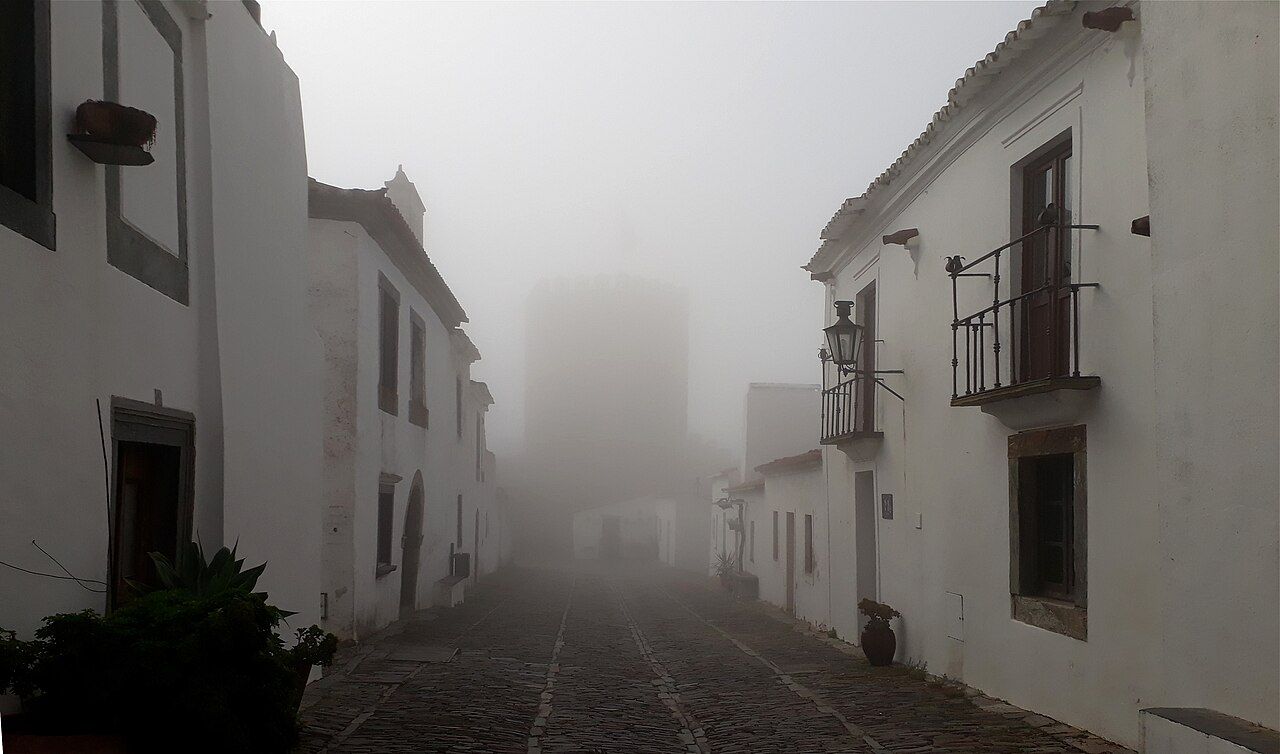
I have a habit of counting steps when a place is best explored on foot. In Monsaraz, that habit feels less like measuring a route than taking in how much is gathered into a few streets: whitewashed houses, the main street, a church, a castle and the walls. Cars are left outside the walls, so the village is crossed on foot. I like that arrangement. It gives the place a clear boundary and makes the walk itself the way to understand it, rather than an interval between parked car and destination.
Monsaraz is a walled medieval village on a hilltop in the municipality of Reguengos de Monsaraz. The main entrance through the walls is the Porta da Vila. From there, Rua Direita is the main street, and the handful of streets makes the village easy to hold in mind. I prefer this smallness to a place that keeps promising another quarter just beyond the one already seen. There is enough to pause over, but no need to make an itinerary out of every turn. The walls set the scale; the whitewashed houses keep it human.
The village and its castle
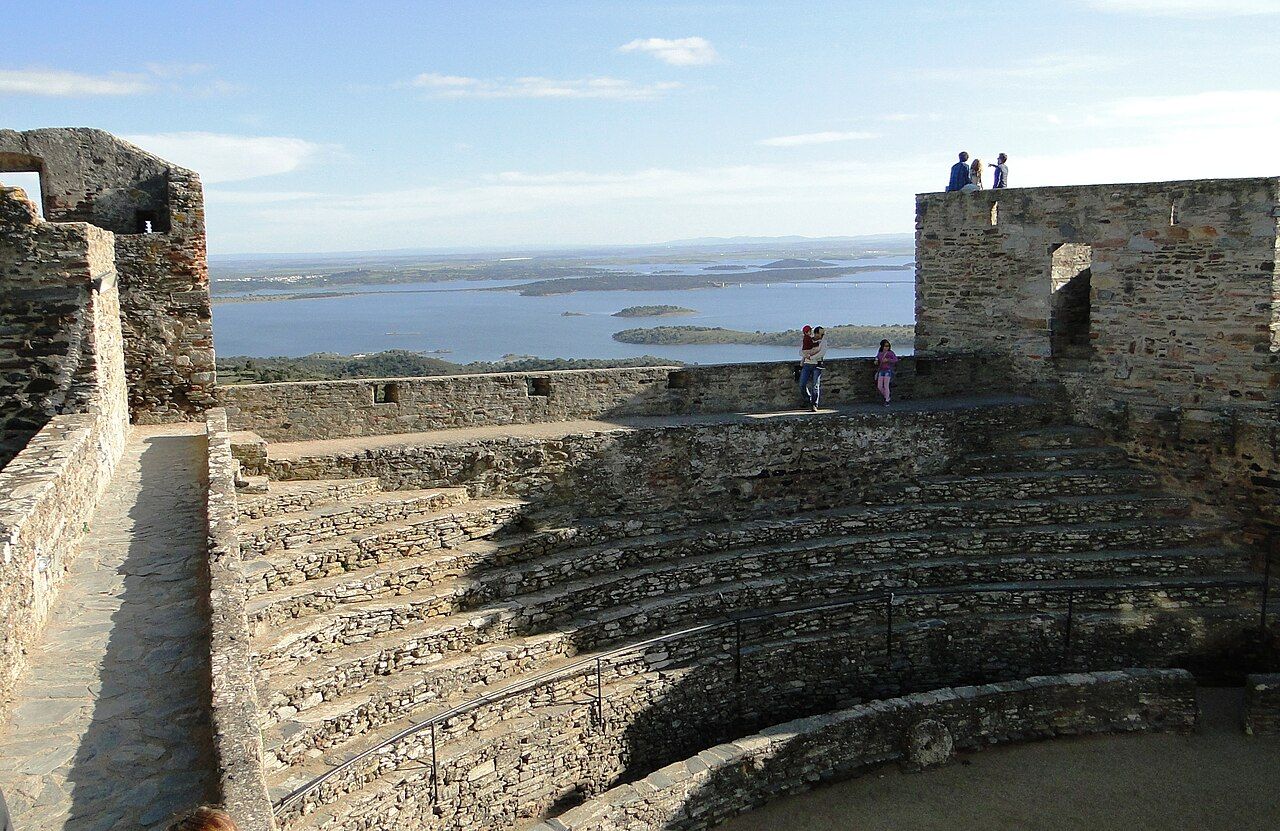
The castle stands at the far end of the village, a destination with a proper sense of arrival even though the walk to it is part of the point. It was rebuilt in the reign of King Dinis. Inside the castle walls, the old parade ground is used as a bullring. That is the detail I keep returning to: a space made for military display now put to a very different use, without losing its place at the centre of the castle. Monsaraz is not a village where the past stays neatly behind glass. Here, an old ground still has a purpose.
The castle stands at the far end of the village, a destination with a proper sense of arrival even though the walk to it is part of the point.
The church gives the walk another point of focus. The Igreja Matriz de Nossa Senhora da Lagoa was built in the 16th century, and a pillory stands in front of it. I like the contrast: the church and the pillory share the same foreground, one a place of worship, the other a reminder of public authority. The pillory is not an incidental object to hurry past. It makes the village’s history feel less abstract, while the church anchors the main streets in a particular place and time.
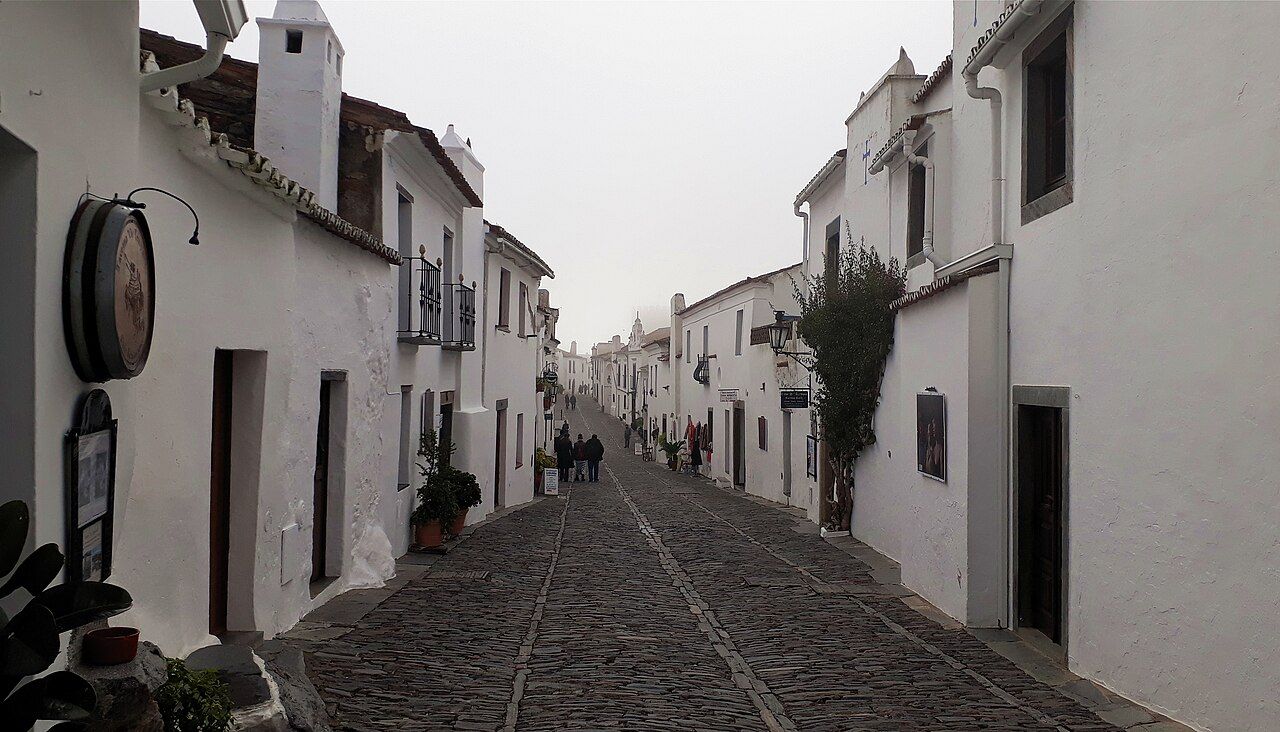
Monsaraz was taken from the Moors in the 12th century by Gerald the Fearless. The seat of the municipality later moved from Monsaraz to Reguengos in the 19th century. Those two changes help explain why the village can feel both concentrated and set apart: it was once a place of authority, and then that role moved elsewhere. I wouldn’t try to turn this into a grand narrative of decline. The facts are more interesting in their plainness. The old centre remains, and its streets still lead from the entrance towards the castle.
The view and the old court
The Museu do Fresco is in the old courthouse, where a 15th-century fresco shows the Good and the Bad Judge. The painting contrasts a fair judge with a two-faced one, as a lesson for those who judged cases there. I find the directness of that arrangement more compelling than a long explanation: the people judging cases were given a picture of what fairness should look like, and what its opposite was. The old court and the painted warning belong together. It is a small, sharp piece of history, and the sort of thing I would rather linger over than skim past on the way to the view.
From the walls, the view sweeps over the great Alqueva lake and across to Spain. In the evening, the setting sun lights the islands and inlets below the village. That view gives Monsaraz its breadth after the closeness of its streets. I like the contrast: the village is compact enough to cross on foot, but the scene from the walls opens out across the water and beyond. The lake is more than a distant backdrop; it gives the village its striking position. Beyond the walls, the standing stones around Monsaraz belong to the wider landscape too, though the walls and the lake are the pair that hold my attention here.
There is no need to pad out a visit with a long list of stops. The entrance, Rua Direita, the church and its pillory, the old courthouse and the castle give the village its shape. I would leave room for looking, and for walking back through the same few streets with a different sense of what they contain. The view changes the scale of the place; the painted judge gives it a human edge. And when the day turns towards evening, the lit islands and inlets make a fine last thing to carry away.
For a place this small, Monsaraz has unusually good arguments for taking your time.
Photos by Vitor Oliveira from Torres Vedras, PORTUGAL, CC BY-SA 2.0; Ceinturion, CC BY-SA 4.0