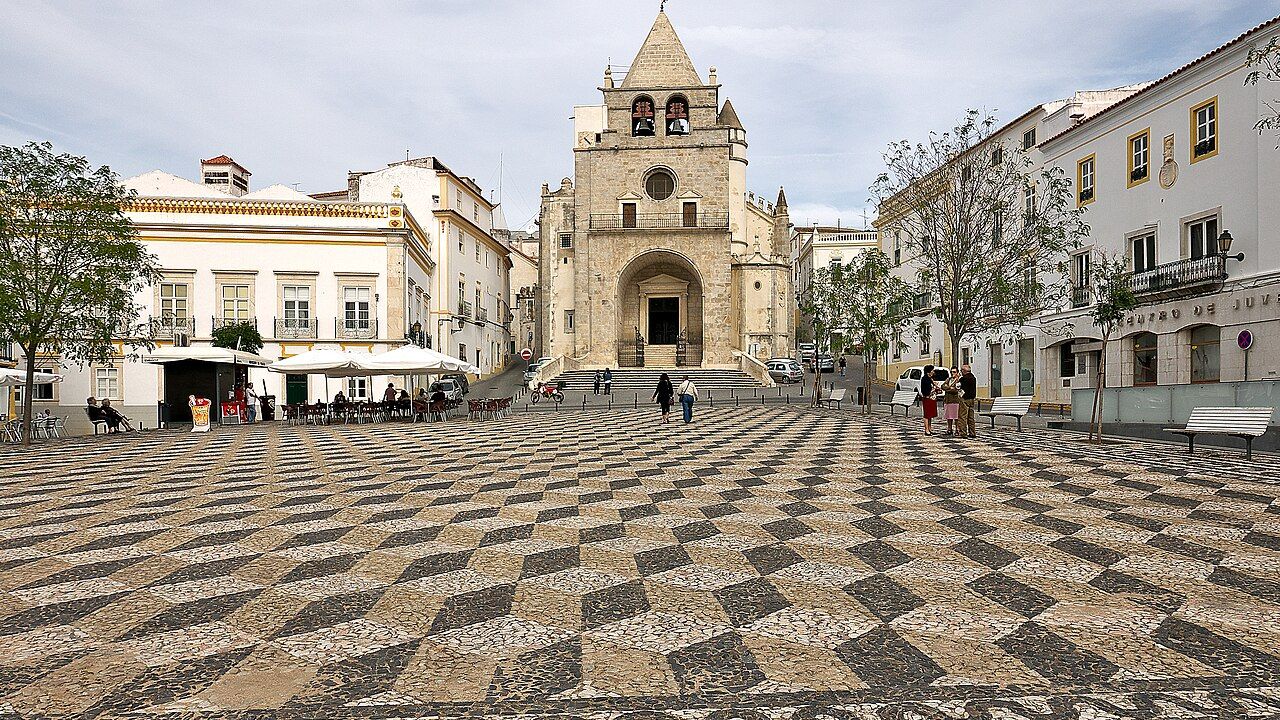
I have a habit of counting steps when a town starts climbing. In Elvas, the narrow white streets rise from the Praça da República towards the castle, and I find myself measuring the walk in small decisions rather than distance. The square is the right place to begin: the heart of Elvas, and a striking pattern underfoot.
What makes the square a good starting point?
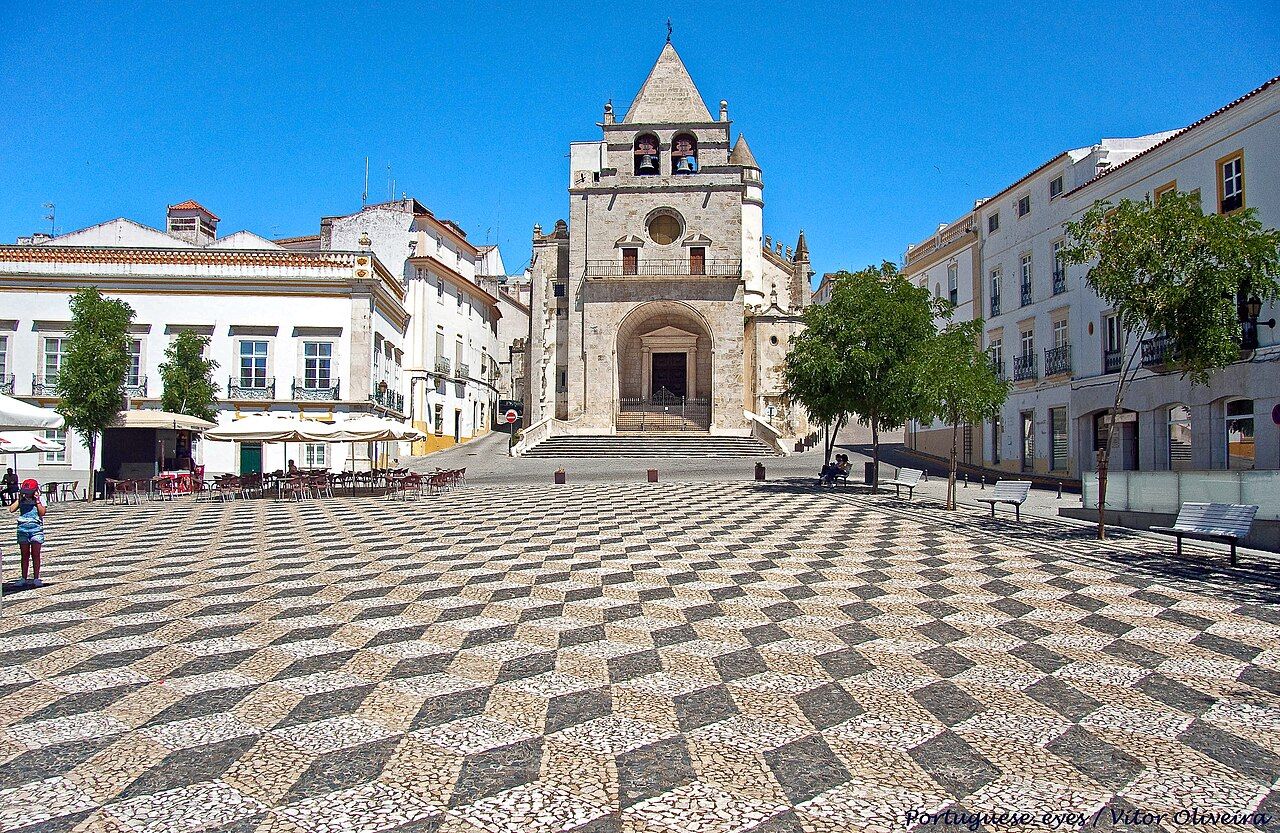
The Praça da República is paved in a geometric pattern of black and white stones. I like a square that gives the eye something to do before the buildings take over, and this one does exactly that. It also makes a useful centre for the walk: the former cathedral stands here, the streets climb away towards the castle, and the next stop is just behind the cathedral. Elvas is compact in the way a town can be when its landmarks seem to lead naturally into one another.
Is the former cathedral still a cathedral?
It is the former cathedral, the Igreja de Nossa Senhora da Assunção. Elvas was the seat of a diocese until 1881, which gives the building’s place on the main square a little more weight than its former title alone. I would not hurry past it just to get uphill. The square and the church belong together: one gives the centre its patterned ground, the other its most conspicuous landmark.
What is behind it?
Behind the former cathedral, the Largo de Santa Clara has a marble pillory and the octagonal Igreja de Nossa Senhora da Consolação. The church’s walls are covered in 17th-century azulejos. That is quite a change of character from the black-and-white paving outside: here the shape of the building and the tiled walls do the work. I find the contrast more interesting than trying to pick a single favourite. The pillory adds another reason to pause in the square rather than treating it as a corridor between sights.
Is the castle worth the climb?
The castle sits at the top of town. It is medieval, on a site with Moorish origins, and the narrow white streets from the main square make the climb part of the experience rather than a separate chore. I like seeing a town rise as I walk through it; counting steps gives my feet something to report back, even if it is not a particularly scientific method. The castle is the natural high point of this route, both on the map and in the order of things.
What should I leave room for?
Elvas is known for its green plums preserved in sugar, the Ameixas d'Elvas, which have protected designation of origin status. They are not an afterthought to the walk; they are part of what makes the town distinct. I would make space for sericaia with Elvas plums, rather than deciding the churches and castle have used up the day’s attention. The military museum, in Elvas’s old barracks, is another stop in the centre.
How does Elvas fit into the border?
Badajoz is about 15 minutes by car from Elvas, a useful reminder of how close the border is. For a walk through the town itself, I would keep the order simple: start on the Praça da República, look behind the former cathedral, then follow the streets uphill to the castle. And if the counting of steps gets tiresome, the plums are a very persuasive reason to stop.
Photos by Axel Cotón Gutiérrez, CC BY-SA 4.0; Diego Delso, CC BY-SA 4.0