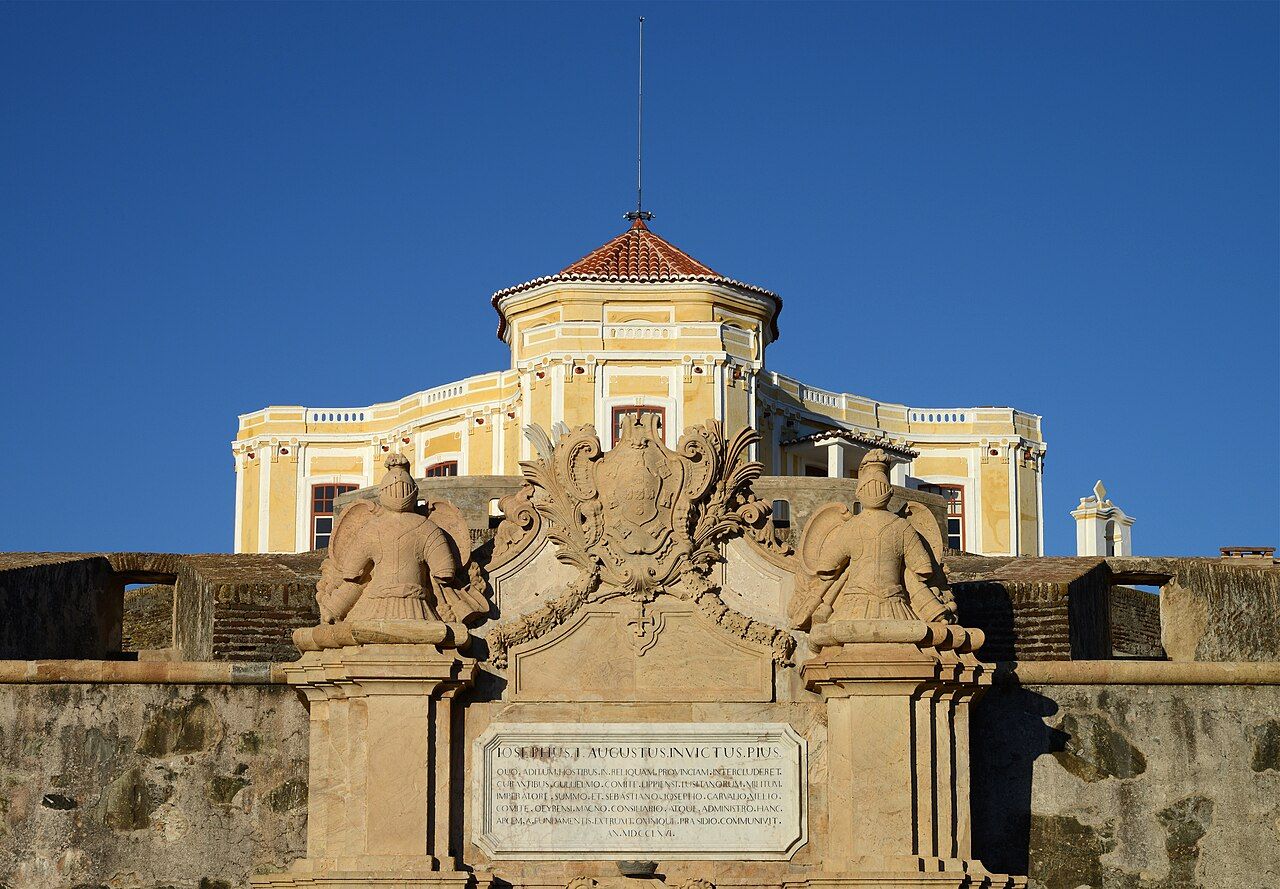
“No enemy could use it to bombard the town.”
What is the Fort of Nossa Senhora da Graça?
It is a hilltop fortress north of Elvas, built between 1763 and 1792 under Count Wilhelm of Schaumburg-Lippe. The work took nearly thirty years, which feels about right for a fort designed to make a strong point and then keep making it. The Count was a German officer who reorganised the Portuguese army, and the fort is also known as the Forte Conde de Lippe after him. I prefer the name that tells you who it is about; the formal name has a chapel’s worth of ceremony, which is perhaps fitting for a place that combines military purpose with a chapel at its centre.
Why was it built on this hill?
The hill overlooks Elvas. That is the whole argument for the site, and a fairly persuasive one: the fort was built so that no enemy could use the hill to bombard the town. I like that the reason for its position is so direct. This is not a fortress placed somewhere simply because it looks impressive from a distance; its position answers a particular threat. The fortifications around Elvas make up a larger story, and the Elvas fortifications belong in the same conversation. Here, though, the hill is the central fact: leave it available to an enemy, and the town below is exposed.
What does it look like?
The plan is square, with bastions at the corners, and deep ditches all the way round. There is a satisfying clarity to that arrangement. The outline feels ordered; the ditches make the separation from the surrounding ground unmistakable. At the centre stands a round building that combined the governor’s residence and a chapel. I find that pairing more interesting than a purely military centre would be. A governor lived there, and a chapel was part of the same central building; the practical and the devotional share the same address. The fort is not hard to read once those pieces are in mind: square plan, corner bastions, deep ditches, round building at the heart.
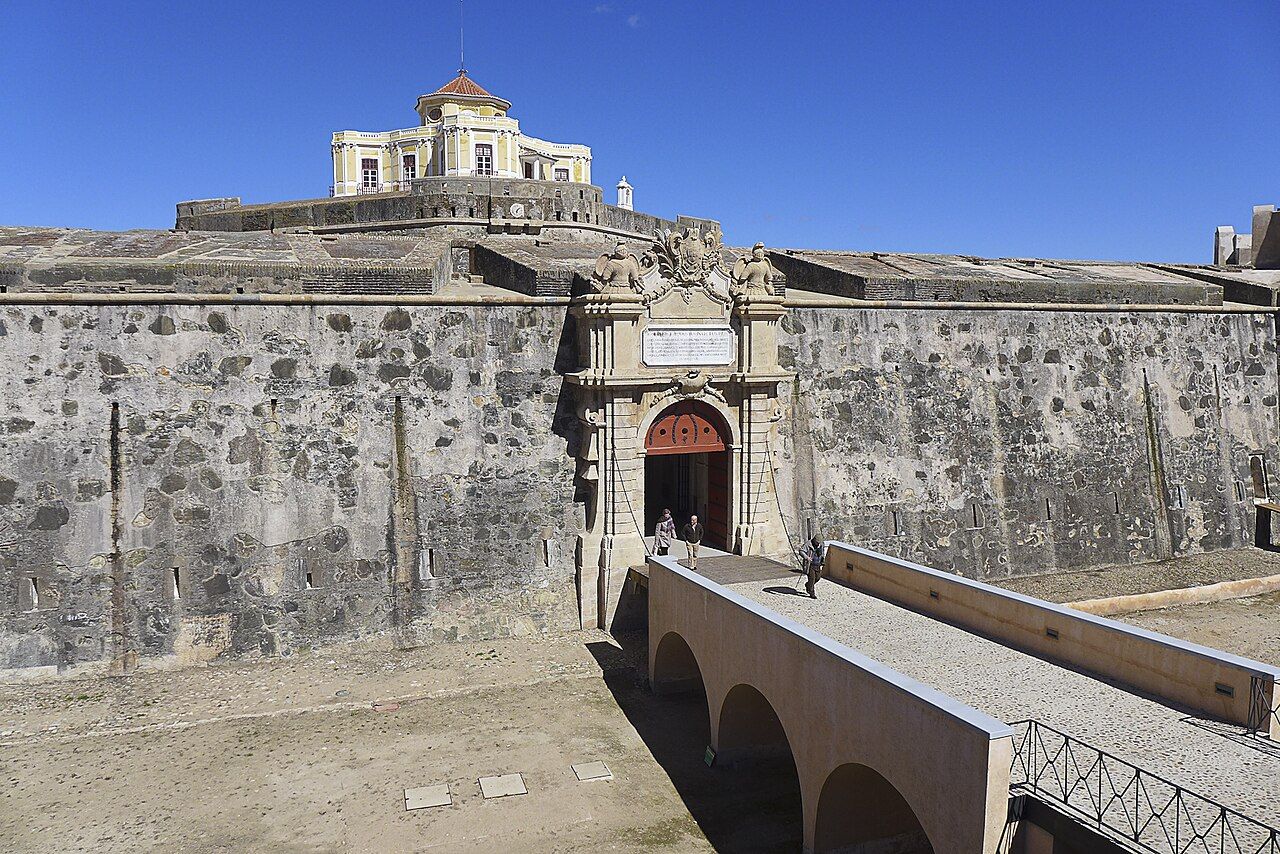
Was it always a fortress?
In the twentieth century, the fort was used as a military prison. That later use changes the way I think about its walls. They were built to stop an enemy making use of the hill, but the fort’s history did not end with that original purpose. A military prison is a harder fact to romanticise, and I would rather keep it in view than let the neat geometry do all the talking. It gives the place another meaning, without taking away the clarity of the reason it was built in the first place.
Can I visit, and what is the view?
After restoration, the fort can be visited, and it is part of the UNESCO listing of Elvas. From its walls, the view spreads over Elvas, the border plain and Badajoz in Spain. I like that the view reinforces the explanation rather than distracting from it: the town below, the broad plain beyond, and the hill that made this position matter. The fort’s shape is easier to appreciate once its purpose is understood, and the view makes that purpose hard to miss. It is a place with a very firm opinion about where it ought to stand. I can respect that. The fort was built to stop an enemy taking advantage of a hill; I would not waste my breath trying to persuade the hill to move.
Photos by José Luis Filpo Cabana, CC BY 3.0; Axel Cotón Gutiérrez, CC BY-SA 4.0