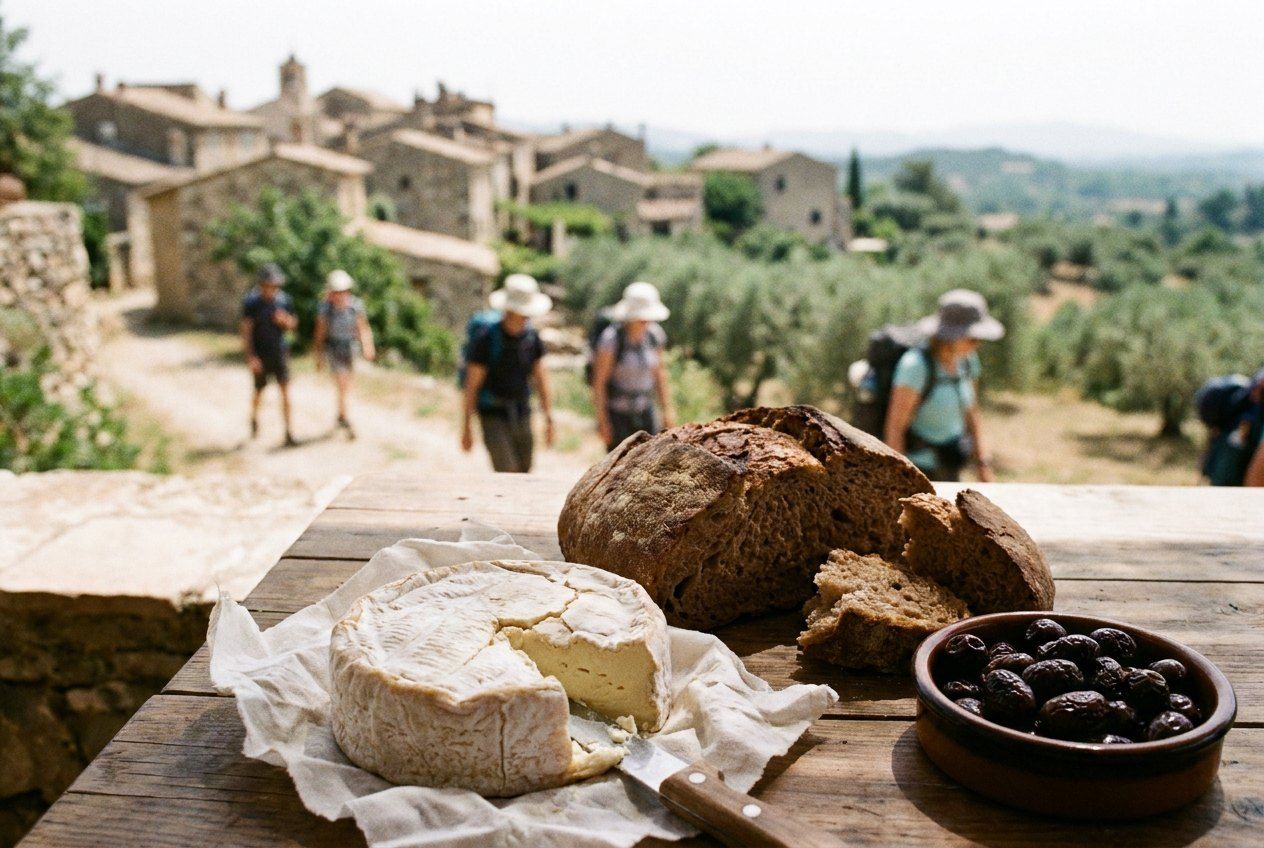
‘Cardo’ is the word to keep in mind. It is the flower of the thistle, used to curdle these cheeses instead of animal rennet, and it leaves a slightly bitter, tangy edge. I like that the difference between them begins with something so specific: not an elaborate recipe, but a plant and the milk of sheep. Most traditional Alentejo cheeses are made from sheep’s milk, though their textures range from soft and buttery to semi-hard, and even from semi-soft to hard.
What do the protected cheeses have in common?
Queijo de Évora, Queijo Serpa and Queijo de Nisa each have protected designation of origin. That matters here because the names are not interchangeable labels for one general Alentejo cheese. They point to distinct cheeses, with differences in texture and in where they come from within the region. All three are sheep’s cheeses; all three are curdled with cardo. The thistle gives them a shared edge, but it does not make them identical. I find that more useful than trying to rank them as if they were competing for the same job.
How do Évora, Serpa and Nisa differ?
Queijo de Évora is small and can be sold semi-soft or hard, so its texture is not fixed to a single point. Serpa comes from the south of the Alentejo and is soft and buttery. Nisa comes from the north and is semi-hard. That is the neatest way to keep them straight: Évora varies between semi-soft and hard; Serpa is the soft one; Nisa sits at semi-hard. I would start with texture rather than trying to choose a winner. The names already give a useful map, and the contrast between Serpa and Nisa is especially clear.
The cheeses belong to a region made across a plain, while around Alandroal sheep graze pastures under cork and holm oaks. I like that simple landscape detail beside the differences on the plate: sheep’s milk is not an abstraction here, but part of the countryside around Alandroal. I would keep the market at Estremoz beside this account as another point of reference for regional food, without muddling the particular character of each cheese.
What does cardo do?
Cardo takes the place of animal rennet in curdling these cheeses. Its contribution is not a loud, overpowering taste; the edge is slightly bitter and tangy. That little sharpness is the detail I would notice alongside the broad differences in texture. A soft, buttery cheese and a semi-hard one do not offer the same feel, even when they share sheep’s milk and the same thistle flower in the making. There is no need to dress the point up: cardo is both a practical part of how they are curdled and a source of their characteristic tang.
How are they eaten?
Cheese is usually served at the start of a meal with bread and olives. That is the useful serving detail, and I prefer it to making a ceremony of the cheese before it reaches the table. A ripe soft cheese of the Serpa type is often opened at the top and spooned out, which suits its soft, buttery texture far better than pretending it should be cut like a hard cheese.
Are there other common cheeses?
Queijo fresco is a mild fresh cheese, and requeijão is a soft whey cheese; both are common too. They round out the picture, though the protected cheeses are the ones with the clearest differences of place and texture. For a simple start to a meal, I would take bread, olives and a cheese whose softness is plain from the first spoonful. The Alentejo’s sheep’s cheeses are better for their contrasts than for any single winner.