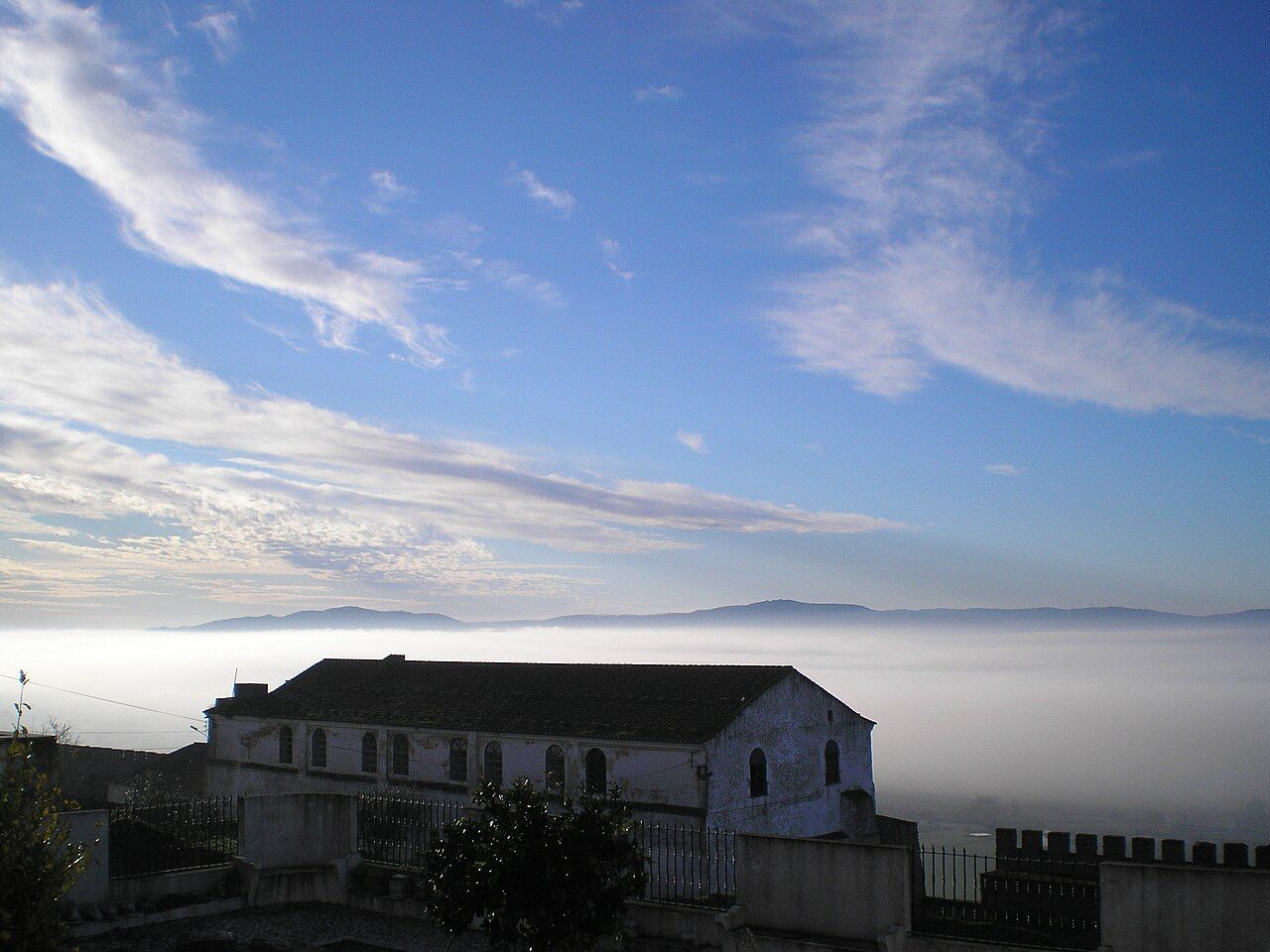
“The highest ground in this part of the Alentejo.”
That is the Serra d’Ossa, a range between Estremoz, Redondo and Évoramonte. I like the way the landscape gives the hills a clear role: the slopes are covered in cork oak, eucalyptus and pine, and roads across the range open out to wide views over the surrounding plains. It is a place to look out from, rather than rush through.
What is the Serra d’Ossa?
It is a range of hills between Estremoz, Redondo and Évoramonte, and the highest ground in this part of the Alentejo. The cover of trees makes it feel distinct from the open plains around it. I would give the roads across the hills more attention than a quick pass between places deserves; those wide views are the point.
What is on the slopes?
Hermits lived in the Serra d’Ossa in the Middle Ages, and a monastery of the Pauline order was founded on its slopes. That pairing is what gives the range more than a scenic role. The trees are what I notice first in the landscape, but the old religious history is the reason to think about who sought out these hills and made a life here.
Why go to Évoramonte?
Évoramonte is a small walled village on a hilltop at the north-western end of the range. Its castle keep has carved stone bands shaped like rope: a detail I prefer to grand claims about castles. From here, the range and village belong in the same outing, rather than as separate pins on a map. The keep at Estremoz makes a useful comparison, but Évoramonte has its own particular detail in those bands.
What happened here?
The Convention of Évoramonte, signed in 1834, ended the Liberal Wars in Portugal. That is a lot of history for a small walled village, and it gives the place a weight beyond its hilltop setting. Redondo lies at the southern foot of the range, while Évoramonte marks its north-western end; the geography helps make sense of the story.
The keep’s rope is carved in stone, so it is no use for tying up loose ends.
Photos by Vitor Oliveira from Torres Vedras, PORTUGAL, CC BY-SA 2.0; Dirk Stoop, PD the file
